

Only during this month
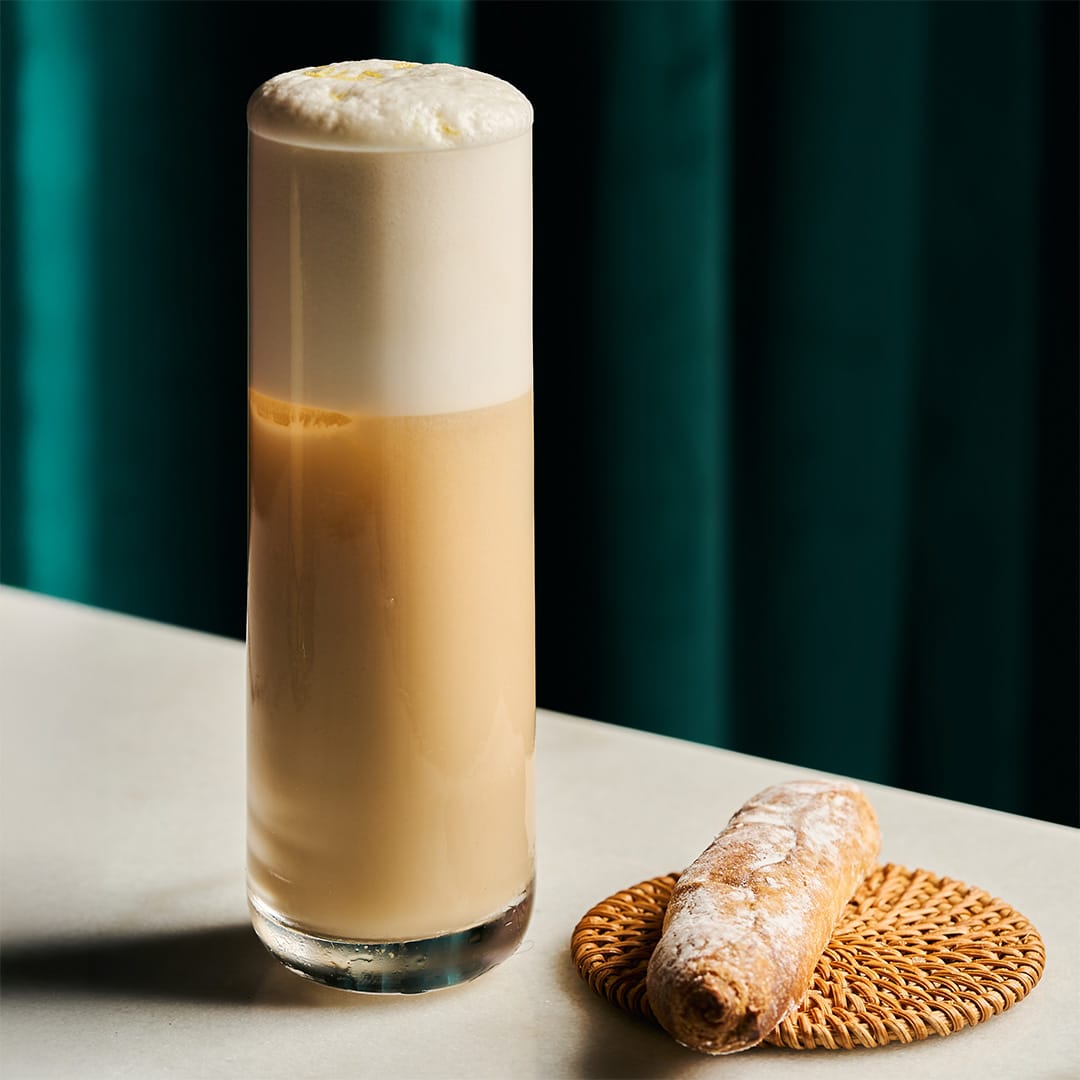
Skyy Vodka infused with vanilla, cinnamon and lemon, Horchata from Horchateria Azul, Borguetti coffee liqueur, Amaretto Bianco Adriatico cream liqueur, Fee Brothers Lime Bitters, Egg white, Homemade Chufa Syrup, Soda topped with Lemon Zest.
Accompanied by a fartón from Paco Tono Bakery at the Mercado Central
Between 1860 and 1920 almost 30 million Europeans arrived in the United States with the promise of achieving their goals, of living the American Dream. It was a new world, full of possibilities, promises and abundance. It is here, in the Land of Opportunities, where our adventure begins.
In this first stage we will learn about the beginnings of the art of cocktails, the cocktails that laid the foundations, the recipes with which it all began.
We do not know for sure who the creator of the Aviation was. What we do know is that the first reference to him is from the famous Hugo Ensslin.
Born in Philadelphia at the end of the 19th century. Created by Ambrose Burnside, bartender at the Clover Club, a stylish club in the city.
New York, 1910. The classic James Bond cocktail “stirred but not shaken”.
Great Britain, 1953, James Bond named it Vesper as a tribute to the novel’s main female character, Vesper Lynd.
New York, 1874. The most refreshing gin cocktail, made with the classic “Old Tom” gin.
New York, 1860. The creation of this cocktail is attributed to Jenny Jerome, mother of Winston Churchill.
Kentucky, 1880. The first cocktail in history, created by Colonel James Pepper.
Hollywood, 1970. Marlon Brando’s favorite cocktail in “The Godfather”.
Phoenix, 1930. Its name comes from the effect of the mixture of its ingredients.
USA, 1930. Launched to fame by the series “Sex in the city”.
Florida, 1987. Official cocktail of the International Bartenders Association.
California,1949. A smoother and tastier variation of the original “Black Russian”.
San Francisco, 1920. One of our favorite cocktails. According to the legend, it was created at the Balboa Café. This perfect blend was an ingenious way to get around restrictions in the Prohibition years, as both its color and flavor are reminiscent of iced tea.
Created in the 19th century, since 2008 it has been the official cocktail of New Orleans.
New York, 2011. Created by Joaquín Simó at Death and Company bar as a mezcal-based variant of the last word and paper plane.
New York, 1980s. Invented by a bar owner, Keith Mcnally. The name French Martini comes from one of the drink’s main ingredients, Chambord liqueur.
New York, 2000. Created by Sam Ross when he was working at the famous Milk & Honey bar.
The Corpse-Reviver family of drinks has unclear origins, but what we do know is they are mentioned in cocktail books as early as 1871 in The Gentleman’s Table Guide. This version, was included in Harry Craddock’s famous Savoy Cocktail Book published in 1930.
New York, 1830. The first acknowledged master of mint juleps was Jasper Crouch from Richmond, who identified himself as a Free Person of Color. Was also known as “hailstone” julep or “hailstorm” julep, which included small “hailstones” or pounded small lumps of ice.
New Orleans, 1876. The first reference to fiz is in the 1876 Jerry Thomas Bartender’s Guide, which contains four recipes. The fizz became extremely popular in america during the 1900s, and it’s known as the hometown specialty of New Orleans
Detroit, 1910. The Last Word is a gin-based cocktail originating at the Detroit Athletic Club in the 1910s, shortly before the start of Prohibition.
The true origin of the Martinez cocktail is unclear. Two early stories attribute the making of a cocktail named the Martinez to bartender Jerry Thomas at the Occidental Hotel or by a bartender by the name of Richelieue who worked at a saloon in Martinez, California.
New Orleans, 1938. Created by Walter Bergeron, the then head bartender at what is now the Carousel bar at the Monteleone Hotel. Pronounced ‘Voo-Ka-Ray’ or more correctly ‘Vyuh Cah-ray’, it is named after the French term for New Orleans French Quarter and literally translates as ‘old square’.
Its origins are subject to speculation. It has been proposed that it gets its name from either the South Side district of the city of Chicago, Illinois, or from the Southside Sportsmen’s Club on Long Island. The drink may have been the preferred beverage of Al Capone, whose gang dominated Chicago’s South Side.
Chicago, 1880. The drink was initially called Continental Sour and then Southern Whiskey Sour, also masquerading as a Brunswick Sour and Claret Snap before becoming better known as the New York Sour.
San Francisco, 1990. Tommy’s margarita was conceived by Julio Bermejo at his parents’ restaurant called Tommy’s.
Its origin goes back to the 1937 British Industries Fair, but it did not become popular until the 1950s endorsement by New York’s Club 21 and its recognition by popular culture as the go-to cocktail of the Rat Pack a decade later.
New Orleans, 1918. Philip Guichet invented the drink in Tujague’s, a bar in the French Quarter of New Orleans.
One of New Orleans’ great cocktail icons and a true classic of the golden age. Creamy, citrusy and exceptionally silky, the Ramos Gin Fizz is as delicate as it is demanding, celebrated for its airy texture and refreshing finish.
Hollywood, 1941. Jack Morgan develops a ginger ale that no one buys, and his friend John Martin acquires the rights to a totally unknown brand of vodka. Desperate to make a profit on their products, they create this great cocktail, which they decide to serve in characteristic copper cups. This is how the Moscow Mule was born.
The name comes from the Russian origin of the original distillate and the “kick” that is felt at the first sip. Composed of lime juice, sugar syrup, ginger beer and originally, vodka. Although nowadays it is also usually taken with other distillates.
The original.
The British version.
The Mexican version.
The version with mezcal.
The US version.
The Scottish version.
The Irish version.
The Glasgow version.
The redneck version.
We travel south. Across the border new flavors await us. Here predominates rum and tequila. Music fills the streets. It smells of pineapple, lime, mint…
On our way we will find stories of pirates, slaves, great writers and also the most refreshing recipes.
Havana, 1901. The original recipe.
Havana 1817. One of the quintessential Cuban classics.
Cuba, 16th century. The famous corsair Sir Richard Drake prepared the first known version of this cocktail.
Bermuda, S XIX. National cocktail of the country.
Caribbean, S XVIII. Created by pirates to raise morale.
Tijuana, 1938. The most legendary of Mexican cocktails.
Sao Paulo, 1918. Traditional Brazilian cocktail, created in the 19th century.
The origin of this variant is not known, what we do know is how amazing it is!
Acapulco, 1948. Revive the famous Mexican cocktail with Mezcal. It is said to have been made in Acapulco in 1948 in honor of a certain Margarita…
Cuba, 1921. Hemingway, who didn’t have a taste for sweet drinks but loved rum and citrus, entrusted El Floridita’s long time bartender Constantino Ribailagua to craft a Daiquiri that suited his palate. The writer was so delighted with the recipe that he would drink up to a dozen of them a day, frequently ordering them two at a time.
There is no verified origin of the Illegal Cocktail and there’s nothing particularly illicit about it. The Illegal is reminiscent of a Hemingway Daiquiri but the flavor is complex, smoky and citrus.
A classic Mexican serve, fresh, citrus-forward and lightly saline, where tequila meets grapefruit in a simple yet perfectly balanced combination. Refreshing, direct and effortlessly enjoyable.
A more expressive and festive take on the traditional Mexican tequila highball. Brighter, bolder and layered, with a vibrant profile where sweetness, acidity and a subtle spicy edge come together in perfect harmony.
Íquique (Chile), 1872. The story goes that an English sailing ship called Sunshine docked in the Port of Iquique. In it was Elliot Stubb, the butler. Stubb fell in love with that place and set up his bar there. He is credited with possibly the most famous cocktail in the world: the Whiskey Sour.
Originally, this cocktail has whiskey as the base alcohol. Lime juice, sugar syrup, egg white and a few drops of Angostura bitters are added to it, all mixed in a cocktail shaker. Currently, whiskey is usually replaced by any other type of distillate.
Served with Wild Turkey bourbon.
Served with Diplomático Mantuano.
Served with Pisco Barsol Quebranta.
Served with Gozio Amaretto.
Served with Espolón Reposado.
Served with La Hacienda Sotol
Served with Amor de Maguey.
Served with Ole Smoky Moonshine.
Served with Glen Grant Arboralis.
Served with Bushmills Black Bush.
We follow in the footsteps of Ernest Raymond Beaumont-Gantt, the booze smuggler who brought tiki culture to America. We cross the Pacific in search of the myths of the hundreds of islands that make up Polynesia. We immerse ourselves in all those stories that speak of cannibals, vengeful tiki gods, the strength of volcanoes… Rum, juices and characteristic moai-shaped glasses predominate.
Bahamas, 1920. Exquisite Caribbean cocktail, in its original version.
A tropical, creamy and indulgent cocktail born in the Caribbean, where ripe banana, coffee and rum come together in a smooth and comforting blend. Refreshing, decadent and unmistakably dessert-like.
An intrepid bartender in the late 1930s managed to harness the destructive force of a hurricane and put it into a cocktail!
Oakland, 1944. Originally from California.
This drink with quite tropical and beach touches dates back to long before the popular TV show existed.
Singapore, 1915. Another of our favorite cocktails.
Hawaii, 1957. The drink was created by a bartender named Harry Yee at the Hilton Hawaiian Village in Waikiki.
We return to Old Europe. We walk the cobbled streets of Rome, the Parisian cabarets, we consume the London night while the bells of Big Ben ring in the background. We rediscover old smells and tastes that remind us of who we are and where we come from.
Paris, 1920. Created to satisfy the tastes of Americans in Paris, it was created for Erskine Gwynne, who edited a monthly magazine called “the Boulevardier”.
Italy, 1919. One of the most famous cocktails in the world, created by Count Negroni.
London, 1984. Cold cocktail flavored with coffee.
Paris, 1921. An internationally famous cocktail.
London, 1999. The most glamorous.
London, 1980. Born in London’s Soho, it is a balanced cocktail between citrus and sweet.
Milan, 1800.The story of the Americano dates back to the second half of the 1800s in Gaspare Campari’s bar in Milan. The nickname “Americano” was born when Primo Carnera, a giant Italian boxer, became world heavyweight champion at New York. When Carnera returned to Italy with the title, he was greeted with this very Italian cocktail which, for the occasion, was called “Americano”.
London, 1922. Created by Hery Mc Elhone, at Ciro’s Club in honor of a famous woman who was getting married.
The bee’s knees cocktail has unclear origins. It was possibly invented by Frank Meier, an Austrian-born, part Jewish bartender who was the first head bartender at the Ritz in Paris in 1921.
Brussels, 1949. The Black Russian cocktail is ascribed to Gustave Tops, a Belgian barman, who created it at the Hotel Metropole in honor of Perle Mesta.
The exact origin of the sidecar is unclear, but it is thought to have been invented around the end of World War I in either London or Paris. The drink was directly named for the motorcycle attachment, which was very commonly used at the time. The Ritz Hotel in Paris claims origin of the drink.
The original recipe for the white lady was devised by Harry MacElhone in 1919 at Ciro’s Club in London. He originally used crème de menthe, but replaced it with gin at Harry’s New York Bar in Paris in 1929. According to the American Bar at the Savoy Hotel, the drink was created there by Harry Craddock.
It may be named after the tool for drilling small holes (alluding to its “piercing” effect on the drinker) or after the surgeon Rear-Admiral Sir Thomas Gimlette (1857–1943), who is said to have first added lime cordial to gin to help combat the ravages of scurvy on long voyages.
Italy, 1950. The cocktail became a symbol of social life and the Italian summer. The Aperol Spritz is characterized by its bright orange color, its effervescence and its balanced and accessible flavor.
Paris, 1920. Conventional belief credits the cocktail to Harry’s New York Bar in Paris, where acclaimed bartender and author Harry MacElhone, supposedly created it in the 1920s.
The Basil Smash was conceived by Jörg Meyer in Hamburg, 2008. The drink quickly became a smash hit, even winning “Best New Cocktail” at the 2008 Tales of the Cocktail Spirited Awards.
After thousands of kilometers traveled we have returned home. After visiting hundreds of places, getting lost in all the cities, all the jungles and the seas. In our mind remains the memory of hundreds of flavors and smells. Now all you have to do is put everything you’ve learned into practice.
The drink that Frida would have for breakfast, but with a spicy touch.
There are many ways to cross the border, with this cocktail you do it flying. (while stocks last)
Our favourite. Sweet, creamy, spicy and smoky.
It will make “From Dusk Till Dawn” a children’s movie.
Fusion of Mexican and Moroccan flavors, spicy, sweet, creamy cocktail with a spicy touch.
A cocktail that takes you to the Beyond with an explosive mixture.
So that the night does not break.
Drink with a strong tropical character.
Tiki-style cocktail, refreshing, smooth and with a citrus sweetness.
The smoothest and creamiest.
Hollywood, 1930. The name comes from the effect it causes when drinking it.
For lovers of olives, a refreshing cocktail, with citrus and sweet notes and great balance.
Asia in your mouth.
Cucumber exists beyond gin and tonic.
Our particular version of Negroni.
A sour with excellent floral nuances that will make your palate dance.
In honor of Mr. Buchanan
The coolest cocktail in hell, dare with it, sweet and spicy!
Elegant, full-bodied, intense, the drink that would surely have captivated the exquisite palate of Mr. Jay Gatsby.
Excellent fusion of smoked whiskey and smoked mezcal, nuances of earth, smoke and barrel that make this drink a delight for the most exquisite.
Version of the classic Negroni but in a transparent shade, with intense floral touches and softer than the classic.
For citrus lovers, we find the power of yuzu, balanced with matcha tea.
Vanilla version of the classic Espresso Martini, it cannot be missing.
In honor of our land, Alicante-style version of the classic Espresso martini
If the Revolution had a flavor, it would be this Margarita: bold, unique and with the salty touch of pickles.
A floral, delicate low-alcohol fizz. Creamy, well-balanced.
A Mediterranean take on the classic Rebujito. Citrus, fresh, saline.
Our selection of non-alcoholic cocktails. We hope you have a good excuse.
Non-alcoholic version with touches of citrus and a slight spiciness from ginger, exquisite!
Non-alcoholic version for the most tropical, the perfect balance between sweet and refreshing.
Non-alcoholic version of the Espresso Martini with a subtle hint of coconut.
Non-alcoholic version of our beloved Llorona.
Non-alcoholic version with a smoky touch of the classic Bloody Mary
